
Blokus Board Game Review | Is It Worth Buying?
I'm a dad who fell back in love with board games so I could play them with my two kids, and now I share honest, parent-first reviews of what we love. I'm not on social media, I quit it a long time ago.
The Quick Answer
Blokus board game review for families: is it worth buying, how the 2 to 4 player corner rule works, what the strategy feels like, and when to choose Blokus Duo.
I am Spector, a dad to Alex, 7, and Emma, 10. Blokus looks simpler than it is. The first turn takes seconds, but every piece changes the corners available to you and to everyone else. That combination of easy teaching and real spatial planning is why it still works at our family table.
Blokus is not a heavy strategy game. It has no dice, cards, or hidden information. It is a pure placement game where the board slowly closes around you. That makes it a strong first strategy game, a quick game after dinner, and an easy game to take to a restaurant or a relative’s house.
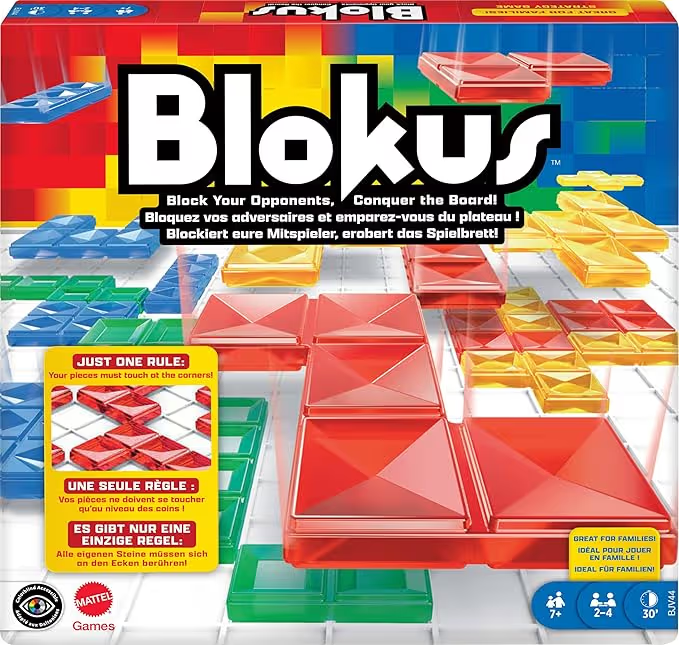
The Amazon links below are affiliate links. If you buy through them, we may earn a commission at no extra cost to you.
Blokus Review Quick Decision
Choose Blokus for simple rules, pure strategy, and a 20 to 30 minute family game. Choose Blokus Duo for two players, Patchwork for less blocking, or Azul and Carcassonne when you want more planning.| What you want | Best fit | Why it fits | Main trade off |
|---|---|---|---|
| The classic family strategy game | Blokus | One rule, 84 pieces, and a short session for 2 to 4 players | The fixed board and piece set become familiar |
| A focused two player game | Blokus Duo | Smaller board and two color sets make the duel more direct | It is a different product, not the standard four player experience |
| Shape fitting with less direct blocking | Patchwork | Personal boards reduce the amount of space you take from another player | It is a different game with more economic planning |
| More planning and a beautiful board | Azul | Tile drafting adds more pattern and placement decisions | The rules and scoring take longer to understand |
| Tile placement with a lighter footprint | Carcassonne | Players build a landscape and claim features as tiles appear | It has more theme and less of Blokus’s pure corner puzzle |
| A portable abstract duel | Hive | No board is needed and the Queen Bee creates a clear target | It is a more combative game with a different movement system |
What Is Blokus and Who Should Buy It?
Blokus is a 2 to 4 player abstract strategy game for ages 7 and up. It uses 84 plastic polyomino pieces on a 20 by 20 board, with no dice, cards, or random draw.Bernard Tavitian designed Blokus in 2000. The game looks like a colorful grid, but the real interest is the way one placement creates new corners and removes future options. Each player receives 21 pieces in one color. The four standard colors are red, blue, green, and yellow.
The standard game is best when the table wants a short, competitive game that does not depend on luck. It is less suitable when someone wants a theme, a cooperative goal, or a large negotiation. The pieces are abstract by design, and the competition comes from blocking space rather than managing resources or telling a story.
Blokus is also a useful game for children because the basic rule is visual. A child does not need a long rules lesson to understand that a piece must touch another piece at a corner. The strategy takes longer to understand, but the first game is playable quickly.
If you are deciding whether a younger child can handle the spatial demands, our Blokus age guide explains the difference between learning the rule and enjoying the strategy.
How to Play Blokus
To play Blokus, place your first piece in your corner, then take turns placing pieces that touch one of your own pieces at a corner without sharing an edge. The player with the fewest unplaced squares wins.Here is the short version of the rules:
- Place the board in the center of the table and choose a color.
- Take all 21 pieces in that color.
- In a four player game, each player starts from a different corner.
- Place your first piece so it covers your starting corner.
- On later turns, place one piece so it touches at least one piece of your own color at a corner.
- Your pieces may not share an edge with another piece of your own color.
- Different colors may touch along edges or corners.
- Continue until no player can make a legal move.
- Count the squares left in each player’s unused pieces. The player with the fewest wins.
The official game also includes variations for two and three players. With two players, each person can control more than one color. With three players, one color is handled differently under the official rules. The four player setup gives the clearest picture of how the game is designed to play.
The Blokus how to play guide has a fuller setup walkthrough and scoring reference.
Basic and advanced scoring
The standard game compares the number of unused squares. The official rules also describe an advanced scoring option with bonuses for placing every piece and for placing the single square piece last. The basic comparison is enough for most family play, while advanced scoring gives repeated players another reason to keep the score sheet.
Is Blokus Strategic?
Blokus has light rules and meaningful strategy. The important decisions are where to expand, which corners to keep open, and when to place a large piece before the board closes around it.The corner rule creates the whole game. A piece can touch an opponent’s piece along an edge, but it needs a corner connection to one of your own pieces. That means every placement affects two things at once: your own future options and the space an opponent can use.
There is no dice to blame and no hidden information to decode. The result comes from the choices players make with the pieces in front of them. That makes Blokus a good first game for players who want strategy without a long rules book. It also means an experienced player can see several moves ahead and make the game feel much less simple than the setup suggests.
Simple strategy principles
These are house strategy ideas, not extra official rules:
- Place large pieces early while the board has room.
- Keep at least one open direction for your smaller pieces.
- Watch the corners your opponent creates, not only the spaces they occupy.
- Do not block an opponent if doing so cuts off your own best future move.
- Think about the small square piece near the end. It can be valuable when the larger pieces no longer fit.
- Treat the first few placements as long term commitments. A fast start can create a dead end later.
The game has no luck, but it does have study. Players who overthink every turn can slow the table down, so a timer is useful if your group tends to stare at the board.
Blokus for Families and Kids
Blokus suits families with children ages 7 and up who enjoy a short, competitive strategy game. The publisher lists 2 to 4 players, and the colorful pieces make the first turn easy to understand.The game works well with mixed ages because children can participate before they understand the deeper strategy. An adult can explain the corner rule in a sentence, then let the table discover the consequences. There is no reading during the game once everyone knows the basic placement rule.
The tactile pieces are part of the appeal. They are easy to pick up, rotate, and place, and the board makes the result visible to everyone. Mattel also says the piece patterns help players identify colors, which is useful for some color vision differences. The game still uses color in the presentation, so a family with specific accessibility needs should try it before buying.
The main family drawback is blocking. A child can understand the rules and still dislike watching an adult take the space that would have connected two corners. That is a normal response to a competitive game, not a failure in the rules. Our games like Blokus alternatives guide has options for groups that want the spatial puzzle with less direct conflict.
Blokus vs Blokus Duo and Similar Games
Choose the original Blokus box for a family game with 2 to 4 players. Choose Blokus Duo when the main goal is a focused two player duel, and choose Patchwork, Azul, Carcassonne, or Hive when you want a different kind of spatial game.Blokus Duo is not simply the standard game with two players removed. It is a separate two player product with its own board and two color sets. That makes it a cleaner choice for a couple who wants a direct duel and does not want to manage the standard box’s two player variation.
Patchwork keeps the shape fitting appeal but gives each player a personal board. It reduces direct blocking and adds buttons, fabric choices, and a different economic rhythm. Azul offers more pattern planning and a stronger theme, while Carcassonne builds a landscape through tile placement. Hive removes the board entirely and changes the goal to surrounding an opponent’s Queen Bee.
If you enjoy the spatial pressure of Blokus but want to keep the conversation going, our Blokus twists and variants guide covers Team Blokus, Trigon, and other ways to change the base game.
Where Blokus Falls Short
Blokus falls short for groups that want deeper tactics, more theme, or a different experience every game. The fixed board and piece set make it a classic rather than a constantly changing system.The replayability comes from the choices, not from new components. The board does not change, the pieces do not change, and experienced players will recognize the same strategic problems. That is not a flaw for a family classic. It is a reason to rotate Blokus with another game rather than expect it to carry every game night.
Blokus can also produce a strong experience gap. A new player sees a colorful board and simple rule. An experienced player sees corners, dead ends, and five move plans. If the family wants a game that explains itself equally well to every age and skill level, Patchwork or a cooperative game may be a better fit.
Blokus Review Verdict
Blokus is worth buying for a family that wants a compact, luck free strategy game with one memorable rule. It is a strong first strategy game, a reliable travel game, and a better fit for direct competition than for negotiation or cooperation.The standard Blokus box earns its place because it does one thing well. It gives players a clear rule, a visible board, and enough spatial tension to make a 20 minute game feel meaningful. Children can join, adults can plan, and the game travels without a mountain of components.
Blokus FAQ
Is Blokus worth buying?
Blokus is worth buying for families and beginner strategy players who want a short, luck free game with one simple rule. Choose Blokus Duo for a focused two player game, and pass if your group wants deeper tactics or more varied decisions.How many players can play Blokus?
The standard Blokus game supports 2 to 4 players. Four players gives the clearest competition, while the official two and three player variations change the color control and table feel.How long does a game of Blokus take?
A game of Blokus usually takes about 20 to 30 minutes. A first game can take longer while players learn the corner rule, but the short playtime makes it easy to fit into a family game night.Is Blokus suitable for children?
Mattel lists Blokus for ages 7 and up. Younger children can learn the basic placement rule with help, but the spatial planning and blocking may not be as enjoyable until a child is ready for the deeper decisions.What is the difference between Blokus and Blokus Duo?
Blokus is the standard family game for 2 to 4 players. Blokus Duo is a separate two player product with a smaller board and two color sets, designed for a more focused duel.How do you win Blokus?
In the basic game, the player with the fewest unused squares wins after no more pieces can be placed. The official rules also offer advanced scoring bonuses for specific finishing achievements.Is Blokus Duo better than the original Blokus?
Choose Blokus Duo for a dedicated two player game with a smaller footprint. Choose the original Blokus for the standard four player family experience, the full 84 piece set, and the familiar board.Editorial Standards
We never accept payment for positive reviews. Affiliate links support our work at no cost to you. All games are tested with our family before review.