
Sushi Go Card Game Review | Is It Worth Buying?
I'm a dad who fell back in love with board games so I could play them with my two kids, and now I share honest, parent-first reviews of what we love. I'm not on social media, I quit it a long time ago.
The Quick Answer
Sushi Go card game review for families: is it worth buying, how the 2 to 5 player pick and pass game works, and when Sushi Go Party is the better choice.
I am Spector, a dad to Alex, 7, and Emma, 10. I first played Sushi Go at a game night and expected another lightweight card game with little underneath. The first round changed my mind. Choosing one card, passing the rest, and watching a set of Sushi or Maki cards travel around the table created more tension than the tiny tin suggested.
That is the balance I still value. The rules are short, the game moves quickly, and adults still have to read the table. It is not a deep strategy game, and it does not offer much direct interaction. It is a clean first drafting game, a reliable travel game, and an easy addition to a family shelf.
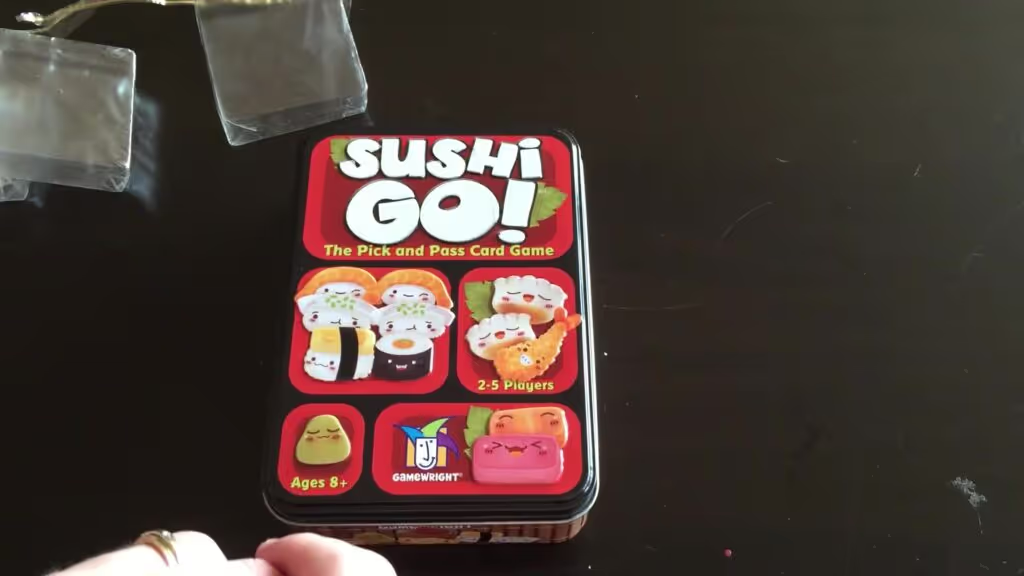
The original Sushi Go tin keeps the whole game in a small card sized package.
The Amazon links below are affiliate links. If you buy through them, we may earn a commission at no extra cost to you.
Sushi Go Card Game Review: Quick Decision
Buy the original Sushi Go tin for a family game night, travel, or a first card drafting game. Buy Sushi Go Party! when you need more players or more variety, and choose 7 Wonders when you want deeper decisions.| Buying question | Game | Why it fits |
|---|---|---|
| Best simple card game for a family | Sushi Go | Two to five players, a 15 minute format, and a tin that travels well |
| Best choice for a larger group | Sushi Go Party! | Supports two to eight players and changes the menu between games |
| Best step up for strategy players | 7 Wonders | Adds resources, building choices, and longer term planning to card drafting |
| Best alternative for a different quick card game | Point Salad | Uses open drafting and vegetable scoring instead of a passed hand |
Sushi Go is the better purchase when the tin itself matters. It fits in a backpack, takes less space than a larger strategy game, and can start in a few minutes. Sushi Go Party! is the better purchase when your group regularly grows past five players or when the fixed card set starts to feel repetitive.
What Is Sushi Go and Who Should Buy It?
Sushi Go is a compact pick and pass card game for 2 to 5 players, recommended for ages 8 and up, and designed by Phil Walker Harding. It is a strong first purchase for families who want a short game with more thought than the artwork suggests.Sushi Go was designed by Phil Walker Harding and released in 2013. Gamewright describes it as a pick and pass card game. Players take one card from a private hand, place it face down, and pass the remaining cards to the next player. The goal is to collect the most valuable combinations over three rounds.
The basic facts are simple:
- 2 to 5 players
- About 15 minutes
- Ages 8 and up
- 108 cards
- Three rounds
- Low complexity
- Limited direct player interaction
The game works because children can recognize the pictures while adults manage the scoring. That does not mean every child will enjoy the full strategy. The best family fit is a group that can accept a light game and still enjoy the small decisions.
If you are teaching the game to children, our Sushi Go teaching guide has a simpler setup for the first round. For a different card game with the same family appeal, compare our best games like Sushi Go.
Buy Sushi Go for these players
Sushi Go suits:
- Families who want a game that starts in minutes
- Children who can recognize cards but do not want a long rules lesson
- Casual players and non gamers
- Travelers, commuters, and people waiting for a table
- Players who enjoy card drafting but do not want a heavy strategy game
Pass on Sushi Go for these groups
I would skip the original tin when:
- Your group regularly needs six or more players
- Everyone wants deep planning and long term strategy
- The group dislikes games with limited direct conversation
- You want a different experience every session rather than a fixed card set
- A heavier game such as 7 Wonders fits your group better
The game has no timer and no long setup, but the low interaction is real. Passing a hand can feel quiet compared with a game where players negotiate, bluff, or build together.
How to Play Sushi Go
To play Sushi Go, shuffle the 108 cards, deal each player a private hand, and repeat three rounds of taking one card and passing the rest. The player with the highest score after the final Pudding scoring wins, with Pudding cards breaking a tied score.Here is the short version of the rules:
- Shuffle the deck and deal the starting hands. Players receive 10 cards with 2 players, 9 with 3, 8 with 4, and 7 with 5.
- Everyone chooses one card from their hand and places it face down.
- Reveal the selected cards at the same time.
- Pass the remaining hand face down to the player on your left.
- Repeat until the hand is empty.
- Score the completed sets, discard the scored cards, and keep Pudding for the final round.
- Deal new hands and play two more rounds.
- Score Pudding after round three. The player with the most Pudding scores 6 points. In a game with more than two players, the player with the fewest loses 6 points.
The full Sushi Go how to play guide covers the setup and scoring in more detail.
What is in the standard deck?
The standard deck has 108 cards. It includes 14 Tempura, 14 Sashimi, 14 Dumpling, 26 Maki, 20 Nigiri, 6 Wasabi, 4 Chopsticks, and 10 Pudding cards.
The Maki cards show one, two, or three roll icons. Tempura and Sashimi score in sets. Dumplings score more as the collection grows. Nigiri cards score differently by type, and Wasabi triples the value of a Nigiri card placed on it.
Wasabi and Chopsticks are action cards, not sushi dishes. Pudding is a final game card. The old description blurred those categories, which made the component list harder to understand than it needed to be.
Is Sushi Go Strategic?
Sushi Go has light strategy rather than heavy strategy. The important decisions are which set you want, which card you can safely pass, and whether a special card is worth more than immediate points.The rules are easy to teach, but a hand can become awkward quickly. A single Sashimi card scores nothing. Two still score nothing. The third completes a set worth 10 points. A single Tempura card also waits for a partner. That creates a tension without adding a thick rulebook.
The player who passes cards matters too. You cannot simply take the card you want and ignore the rest. A card you reject may be the exact card a neighbor needs to finish Sashimi or Tempura. The hand moving around the table makes every choice visible after the reveal.
Sushi Go does not offer deep engine building, resource trading, or long term planning. It also gives players fewer ways to interfere with one another than a game such as 7 Wonders. That is a feature for a family game and a limitation for players who want control over every opponent.
My practical card priorities
These are house strategy choices, not extra official rules:
- Pick a card that fits a set when you already have one or two matching cards.
- Take a high value single card when the set you want is unlikely to arrive.
- Save Wasabi for a valuable Nigiri when you can control the timing.
- Hold Chopsticks until a useful card is likely to reach your hand.
- Track what passed you earlier instead of treating every hand as random.
- Treat Pudding as an end game decision. One card matters, but chasing it too early can cost points.
The Sushi Go strategy guide goes deeper into card priorities and player counts.
What Works at Our Family Table
Sushi Go works at a family table when the goal is a quick shared game, not a showcase of adult strategy. I keep the tin nearby because it travels, starts fast, and gives Alex and Emma a real decision without a long rules lesson.The first time I played Sushi Go, I thought the cute food cards would be too light for an adult game night. The first hand changed that impression. I had to choose between taking a useful card now and passing the card my neighbor needed. The decision stayed with me after the round.
That is the family appeal. Emma can follow the card patterns and start thinking about sets. Alex can join without memorizing every score. My wife and I still enjoy the hand passing when we want a game that does not require a long setup. I have played Sushi Go with family and friends often enough that the first round no longer needs explaining, but the choices still produce stories.
The fixed deck is the tradeoff. The 108 cards do not change, so the game does not offer the same variety as a larger drafting game. The shuffle still sends different hands around the table, and that is enough for us when we want a short game rather than a new production.
For the travel version of the same idea, see why Sushi Go works on the road.
Sushi Go vs Sushi Go Party
Choose Sushi Go for the small tin and groups of two to five. Choose Sushi Go Party! for groups of six to eight, a larger box, and a menu that changes the scoring focus between games.Sushi Go Party! keeps the same broad pick and pass idea but supports two to eight players. It adds a modular menu with more than 20 dishes, so each game can reward different card types. That variety comes with a larger box, more setup, and a longer session.
The choice comes down to the table you actually have. The original supports two to five players, fits in a small tin, and uses one fixed 108 card set. Party supports two to eight players, takes more space, and lets you choose a different menu before each game.
I would buy the original for a couple, a small family, or anyone who wants a game in a backpack. I would buy Party for relatives, regular game nights, and groups that already know they enjoy drafting.
Where Sushi Go Falls Short
Sushi Go falls short when a group wants deep strategy, strong player interaction, or a different setup every game. The original tin is excellent for a narrow family need, but it is not a replacement for every card game.The most common complaint is that the game can feel lonely. Players make private choices and then pass cards. There is little table talk beyond the reveal and the occasional Sushi Go call. A group that enjoys negotiation or shared problem solving may find that quietness disappointing.
The second limitation is repetition. The deck stays the same, so the game relies on changing hands and changing player priorities for variety. Some groups will happily play it for years. Other groups want new mechanisms, more player interaction, or a larger decision space.
Sushi Go Review Verdict
Sushi Go is worth buying for a family that wants a portable, quick card game with light strategy. It is a strong first purchase for beginners and travelers, while Sushi Go Party! is the better box for larger groups and more variety.The original Sushi Go tin gives you a compact game with a real decision every few seconds. The artwork gets children interested, the short rules get them playing, and the hand passing gives adults enough structure to stay engaged. It does not need to be the most complex game on the shelf to earn regular use.
Sushi Go FAQ
Is Sushi Go worth buying?
Sushi Go is worth buying for families, beginners, travelers, and casual groups who want a portable card game that takes about 15 minutes. Buy Sushi Go Party! instead if you regularly play with six or more people or want more card variety.How many players can play Sushi Go?
The original Sushi Go card game supports 2 to 5 players. The publisher lists a recommended age of 8 and up, and the small tin is built for short family or travel sessions.How long does a Sushi Go game take?
A Sushi Go game takes about 15 minutes with familiar players. A first game can take longer while everyone learns the card types and scoring, but the three round structure keeps the session compact.Is Sushi Go good for kids and beginners?
Sushi Go is good for kids and beginners because the core action is simple: take one card, pass the rest, and build sets. Adults can handle scoring while children learn the visual card combinations.What is the difference between Sushi Go and Sushi Go Party?
Sushi Go is the smaller 2 to 5 player tin with a fixed card set. Sushi Go Party! supports 2 to 8 players, usually takes longer, and adds a modular menu with more than 20 dishes for greater variety.How do Wasabi and Chopsticks work in Sushi Go?
Wasabi triples the value of the next Nigiri card placed on it. Chopsticks let you take a second card on a later turn, then return the Chopsticks card to your hand before passing.Editorial Standards
We never accept payment for positive reviews. Affiliate links support our work at no cost to you. All games are tested with our family before review.