
Catan Development Card Bluffs | Win the Mind Game
I'm a dad who fell back in love with board games so I could play them with my two kids, and now I share honest, parent-first reviews of what we love. I'm not on social media, I quit it a long time ago.
The Quick Answer
Catan development card bluffs work because the deck stays hidden. Buy early, play one Knight to hint at Largest Army, and let the table imagine the rest.
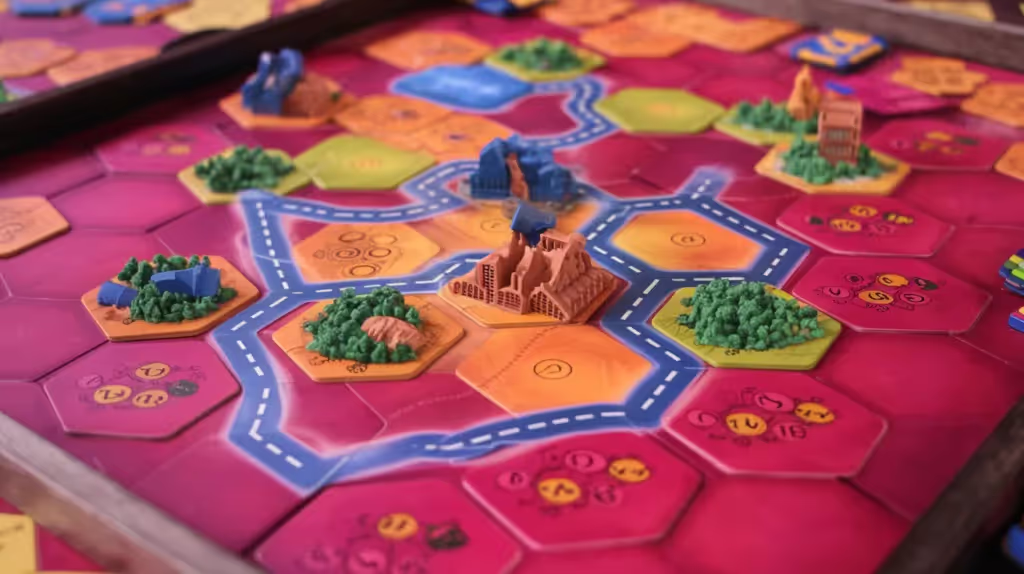
A Settlers of Catan board with settlements, cities, and roads set up for a family game.
Points in Catan are public. So are your buildings, your roads, and every Knight you have already played face up. The one thing nobody can count is the cards in your hand, and that is the entire game of bluffing in Catan.
I am Spector, a dad to Alex, 7, and Emma, 10. Emma learned to bluff before she learned to count pips. She would play a single Knight, say nothing, and watch the table quietly decide she was one card from Largest Army. They were guessing, and she let them.
Here is the honest split before anything else. Bluffing is not in the rulebook. The rulebook never mentions it, and it is not a rule you can argue at a tournament. What the rules do give you is hidden information, because your resource cards and your development cards stay hidden until you use them. Bluffing is house and community play built on top of that one official fact.
The official Catan development card rules before any bluff
The base 3 to 4 player deck holds 25 development cards: 14 Knights, 5 Victory Points, 2 Road Building, 2 Year of Plenty, and 2 Monopoly. Every card costs 1 ore, 1 sheep, and 1 wheat, and you may only buy on your own turn, during the build step.
Everything below is the official rulebook, not strategy. Read it once so nobody argues at the table.
- You buy development cards only on your turn, and only during the build step of that turn.
- A card you buy this turn cannot be played until a later turn. Victory Points are the exception, because you reveal those to win rather than play them.
- You may normally play one development card per turn. You can still buy more than one card in a single turn.
- Played Knights stay face up in front of you. The first player with 3 face up Knights takes Largest Army, worth 2 victory points, and can lose it to a player with more Knights.
- A Knight moves the robber and steals 1 random resource card from an opponent with a building on that hex. It works like a rolled 7 but without the discard rule.
- Keep Victory Point cards hidden. You reveal them on your own turn, only when you are sure you have 10 points and the win.
- Resource cards and development cards stay hidden in your hand until you use them, so showing your hand is not allowed.
That last point is the one that makes bluffing possible. Everything on the board is public, and the hidden part is small, so a bluff is really about controlling what everyone assumes about the few cards you hold. Everything after this section is house and community advice, not a rule.
Why hidden development cards are the best bluffing tool in Catan
Development cards are the best bluffing tool in Catan because they are the only part of your position that stays private. Opponents can count your cities and your played Knights, but they cannot count the cards in your hand. Our Catan development card odds guide shows how likely each draw is, which is also how believable any bluff about your hand will be.
Compare that with the rest of the board. Your settlements and cities are visible, your roads are visible, and every Knight you play is visible. Resource cards stay hidden too, but a resource card has no drama. A development card carries a threat, because your opponents never know whether it is a harmless Road Building or the Monopoly that empties their hand.
That is why the real skill is not lying. It is letting people reach their own wrong conclusion. You never have to say a word about the card you hold, because the table will invent the worst version of it on its own. Your job is to keep the board and your hand consistent, so the guess lands in your favor.
How to bluff with each development card
Each development card bluff works a little differently. This table maps the official effect to the bluff it enables, so you can pick the right one before you need it. For the plain reference on every card first, see our Catan development card types guide.
| Card | What it officially does | The bluff it enables |
|---|---|---|
| Knight | Moves the robber to another hex and steals 1 random resource card, and 3 face up Knights earn Largest Army | Play one Knight and let the table fear a Largest Army push that may never come |
| Victory Point | A hidden point you reveal on your own turn to win | Opponents cannot see it, so they miscount your total and read you as further back than you are |
| Road Building | Places 2 free roads connected to your network | Looks like a Longest Road grab and pulls defenders away from your real target |
| Year of Plenty | Takes any 2 resources from the bank | Hides the resource you actually lacked, so your trades stop announcing your bottleneck |
| Monopoly | Names a resource and takes every card of it from each opponent | The threat of it freezes a resource before you even play the card |
Knight. A played Knight is public, so the bluff is about the Knights still in your hand. Play one early, and let the table start planning for an army you never finish. Our Catan Largest Army guide covers when the race is real and when the threat is enough on its own.
Victory Point. Keep it face down and keep your face still. The hidden point is why a quiet player is dangerous, because the board never shows the card that ends the game.
Road Building. Two free roads can look like a Longest Road push and pull defenders toward the wrong side of the map, even when your real plan is a settlement spot.
Year of Plenty. Taking two resources quietly hides the one you actually needed, so your trades stop announcing your bottleneck to the whole table. Our Year of Plenty guide covers the choices.
Monopoly. The threat often does more work than the card. If the table believes you hold Monopoly, players start spending a resource down or stop hoarding it, and you may never need to play the card at all. Our Monopoly card strategy guide covers the timing.
Advanced Catan bluffing: timing, tells, and double bluffs
The advanced part of Catan bluffing is timing, not theater. A bluff is strongest in the middle of the game, when every player is a few points from the end and one bad turn feels expensive.
Set up the bluff before you need it. If you only get loud when you are close to winning, the table learns your tells fast. If you bluff once early for a small gain, the same move later is far more believable.
Keep a real plan behind every bluff. The point of a bluff is to buy a turn or a trade that helps your actual build, not to win a round of table talk. If the bluff does not move your board forward, it is just noise.
Double bluffs work because players remember your last move. If you bluffed once and got caught, the table will assume the next calm turn is honest. That is the turn to bluff again, or to simply play the good card while everyone expects a trick.
How to read an opponent who is bluffing in Catan
You catch a bluffer by comparing what they say with the public board, because the board cannot lie. Settlements, cities, roads, played Knights, and every trade are visible, so a story that does not match those facts is usually a bluff.
Watch the pattern, not the words. A player who suddenly stops trading, hesitates before a cheap build, or pushes hard for one specific resource is often holding a card that changes that exact resource. A player who counts their Knights out loud usually wants you to notice them.
The reverse also works in your favor. When you are the one bluffing, remember that the table is reading you the same way, so keep your table talk consistent with your real position. The best bluff looks like a normal turn with one small change.
Bluffing mistakes that cost you the game
The most common Catan bluffing mistake is bluffing too often. When every turn is a performance, nobody believes any of it, and the one time you genuinely hold the winning card, the table calls you on it.
Being predictable is the second mistake. If you bluff at the same moment in every game, opponents start timing you instead of reading you. Mix the moments so the bluff stays a real question.
The third mistake is forgetting to build. A bluff that delays your own settlements, cities, and cards loses the game slowly while it wins the argument. The board still decides the winner, so the bluff has to serve the board.
Catan bluffing with kids at family game night
Bluffing can be a warm, funny part of family game night, or it can end with a seven year old in tears, and the difference is how you frame it. We frame a bluff as keeping a secret, never as lying about the board.
That distinction matters for younger players. Alex, at 7, can hold a card and stay quiet, but he cannot yet separate a bluff from a broken promise, so we only let him bluff about his hand and never about the visible board. The visible board stays honest for everyone, which keeps the game fair and keeps the peace.
Emma, at 10, plays the full game. She will drop a single Knight early, watch three players start counting Knights, and then win with a quiet Victory Point while everyone plans around an army that never arrives. That is exactly the skill the rulebook accidentally hands you when it keeps your hand hidden.
If you are still deciding whether the base game is right for your family before you worry about bluffing, our Settlers of Catan review covers who it suits and how it plays at different ages.
- Similarities: Both Catan and the junior version are about collecting resources, trading, and building toward points on an island.
- Differences: The base game keeps development cards hidden and lets played Knights build toward Largest Army, while Catan Junior strips out development cards and the robber entirely.
- Why this game fans will enjoy it: Catan Junior keeps the trading and building fun but removes the hidden information, which is the whole engine of bluffing in the adult game.
Bluffing arrived at our table by accident. Emma played one Knight early, said nothing, and my wife and I spent three turns quietly planning around a Largest Army that Emma never intended to finish. She won with a Victory Point we never saw coming, and the first thing she said was that she never lied, we just guessed. That is the lesson I keep coming back to. The best bluffs in our house are the quiet ones, and we only let the younger players bluff about their hidden hand, never about the board everyone can see.
Frequently asked questions
How do you bluff with development cards in Catan?
Keep the deck hidden and control what opponents assume about your hand. Buy early, play one Knight to imply a Largest Army push, and hold a Victory Point card so nobody can count how close you are to winning.What is the best development card to bluff with in Catan?
A Knight is the best bluff card because it is public when played and it feeds Largest Army. Play a single Knight and the table may assume you hold more, then plan around an army you never finish.Can you bluff with a Victory Point card in Catan?
Yes, and the rule does the work for you. A Victory Point card stays hidden until you reveal it on your turn to win, so opponents cannot see that your total is higher than the board shows.How do you bluff a Largest Army in Catan?
Play one Knight and talk about the army, not your hand. Because the first player with 3 face up Knights takes the 2 point card, one visible Knight is enough to make rivals spend turns and resources racing you.Is bluffing allowed in Catan?
Bluffing is not in the rulebook, but it is not banned either. The rules only require hidden hands and hidden Victory Points, so misdirection about your intentions is house and community play, not a rule.How do you catch someone bluffing in Catan?
Compare what a player says with the public board. Settlements, cities, roads, played Knights, and trades are all visible, so a story that does not match those facts is usually a bluff.When should you not bluff in Catan?
Skip the bluff when you are already ahead and the truth scares the table more. Bluffing too often burns your credibility, and a bluff that delays your own build costs you more than the confusion wins.Editorial Standards
We never accept payment for positive reviews. Affiliate links support our work at no cost to you. All games are tested with our family before review.