
How to Play a Round of The Grizzled | Mission Steps, Tokens and Traps
I'm a dad who fell back in love with board games so I could play them with my two kids, and now I share honest, parent-first reviews of what we love. I'm not on social media, I quit it a long time ago.
The Quick Answer
One round of The Grizzled is one mission: deal the hand, play one card a turn, withdraw with Support tiles, then the Morale Drop. 2 to 5 players, 30 minutes.
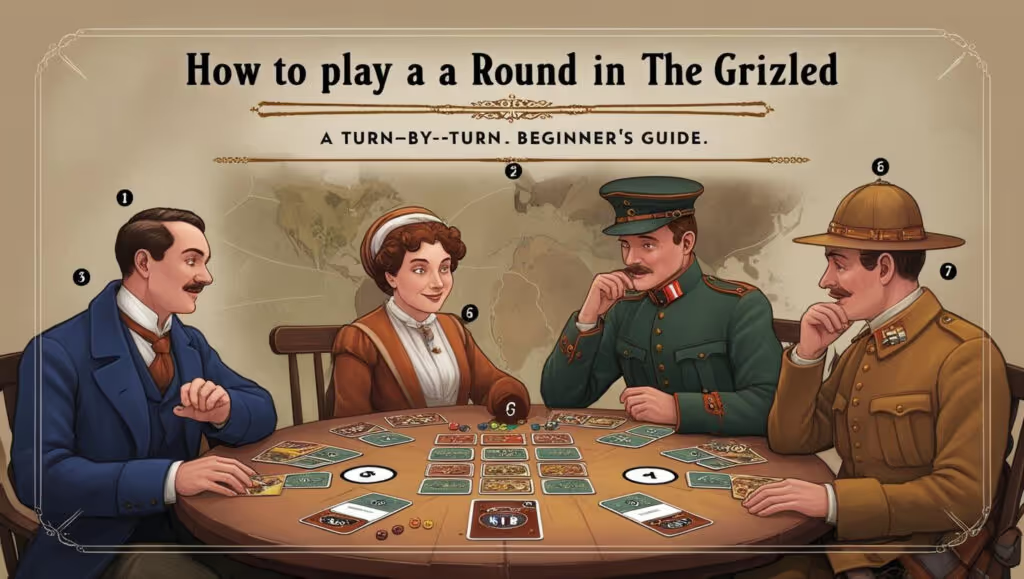
A step by step guide to playing a mission round in The Grizzled, from the deal to the Morale Drop.
The Grizzled is a cooperative card game for 2 to 5 players, ages 14 and up, in about 30 minutes, from designers Fabien Riffaud and Juan Rodriguez. The whole game is a countdown of missions. Survive enough missions and your squad reaches the Armistice; stumble and the Monument card is all that gets revealed.
I learned this loop the hard way at a game night where a friend brought the box. We got my wife and two friends up and running inside one mission, because the round itself is genuinely four steps long. The rulebook looks scary at the start and pages 6 through 9 do all the work. If you want the bigger picture before the rules, the full The Grizzled review covers how it plays over a whole campaign of rounds, and the game at the table is a tense, quiet little thing.
One correction before the rules: an older version of this page described the round as a Mission Phase, a Withdrawal Phase, and a Morale Check, with cards played face down into a mission pile. None of that matches the official rulebook. There is no reveal step, no face down mission pile, and no Support cards. Every number below was checked against version 1.1 of the official US rulebook.
Affiliate disclosure: this page contains Amazon affiliate links. If you buy through one we may earn a small commission at no extra cost to you, and it never changes the verdict below.What one round of The Grizzled is
One round is one mission, and every mission has four steps: Preparation, the Mission itself, resolution with Support, and the Morale Drop, after which the next mission deals again.The countdown works like this. At setup you split the 59 card deck into two piles: 25 cards face down on top of the Peace card form the Trials pile, and the other 34 go on the Monument card as the Morale Reserve. Through mission after mission the group tries to drain the Trials pile with the cards they play. The game is won the moment the Trials pile is exhausted, the Peace card is visible, and no player holds any cards.
The Reserve keeps the pressure on. Every mission that ends moves cards from the Reserve onto the pile, and failed missions recycle their threats back in too, so the countdown can go up as well as down. If the Reserve ever runs dry, the Monument card is revealed and the squad loses the war.
Here is the whole round on one line of each:
| Step | What happens | Numbers to remember |
|---|---|---|
| 1. Preparation | The Mission Leader chooses the intensity and deals that many cards one at a time from the Trials pile | Minimum 1 card, minimum 3 for the first mission |
| 2. The Mission | One of four actions per turn, clockwise: play a card, flip the Good Luck Charm, give a Speech, or withdraw with a Support tile | 6 threat types, 3 identical active threats fail the mission |
| 3. Resolution and Support | Withdrawal ends for everyone, the Support tiles are revealed and delivered, and the most supported player cleans up | Majority clears 2 Hard Knocks or the charm after a success, only 1 after a failure; a player at 4 or more Hard Knocks loses the game |
| 4. Morale Drop | Count the cards left in hand and move that many cards from the Morale Reserve onto the Trials pile | Minimum 3 cards; an emptied Reserve reveals the Monument card and loses |
Those moves make more sense with the deck behind them, so the next four sections walk the steps in order.
Step 1: Preparation, the mission leader deals the hand
The Mission Leader chooses the intensity of the mission, which sets how many cards each player is dealt from the Trials pile, a minimum of 1 that rises to a minimum of 3 for the first mission of the game.Intensity is the only dial the leader actively turns, and the rulebook calls the first mission deal the Flower in the Gun Barrel because it opens at 3 cards each no matter how brave you feel. The deal runs one card at a time, clockwise, starting with the leader, which matters more than it sounds: if the Trials pile runs out mid deal, you simply stop, and some players finish with a smaller hand. When that happens the Peace card is showing, which is exactly the state your team wants to protect.
Nobody skips a turn in a Grizzled mission. If you have not withdrawn, you must pick one action, and the four are laid out in Step 2.
What sits on the table before the first mission
Setup takes about five minutes and every number here comes from the rulebook:
- The 59 Trial cards split into a 25 card Trials pile and a 34 card Morale Reserve, with the Peace card buried at the bottom of the first and the Monument card at the bottom of the second.
- The deck holds 39 Threat cards, where each of the six threats, Night, Snow, Rain, Gas Mask, Shell, and Whistle, shows up 14 times across the set, 9 of those Threat cards also carry a Trap, plus 19 Hard Knock cards and one Merry Christmas card.
- Every player takes a Grizzled card with the Good Luck Charm side up, and the charm shows a threat type you will use later.
- Each player gets 3 Support tiles: one left tile, one right tile, and one drawn at random from the rest. With 2 or 3 players the left and right tiles sit out.
- Speech tokens go in the middle by player count: 5 tokens at 2 or 3 players, 4 at 4 players, and 3 at 5 players.
- The Mission Leader token goes to the hairiest player, which is the only rule my wife has ever fully endorsed.
If you want the card types laid out one by one, our Grizzled card deck beginner guide walks the deck card by card.
Step 2: The mission, one action per turn
On your turn in the mission you choose exactly one action: play one Trials card, flip your Good Luck Charm, give a Speech with a token, or withdraw and play a Support tile, and you cannot pass without acting.The mission runs clockwise from the leader and only ends two ways, which Step 3 covers. Threats land in No Man’s Land, the center of the table, and the whole group loses the mission the moment three identical threat symbols are active at the same time. That includes the symbols attached to players, not just the pile, so the check follows you even when you keep your head down.
The communication rule runs underneath everything: you may talk about what is face up and you may count both piles, but the contents of your hand are never shared. All anyone learns is what you choose to play.
Play a Trials card
Threat cards go face up into No Man’s Land and add their symbols to the shared count. Hard Knock cards are the other type, and you play those onto yourself. The assigned card takes effect immediately, and the ones that matter most to the table, the Phobias and Traumas, each print a threat symbol that counts toward the three identical threat check for as long as you stay in the mission.
That is why a Hard Knock is never a free pass. A Shell Phobia on your side of the table behaves like one more Shell in No Man’s Land while you are still standing, and it is exactly the kind of card a Speech can help you shed from a hand.
Trap cards force another card, immediately
Nine of the 39 Threat cards carry a Trap symbol. When you play one, the rules are brutal and instant: draw another card from the Trials pile and play it straight in. A second Trap on that forced card is ignored, but a Hard Knock on it still lands on you, and the extra card can tip No Man’s Land over the three identical threat line and fail the mission before anyone else moves.
For your first games, the rulebook itself tells you to ignore Traps entirely and add them once the loop feels easy. Take that mercy while it is offered; the traps are not going anywhere.
Use your Good Luck Charm
The Good Luck Charm clears a whole threat instantly. When it is your turn, flip action to the charm: choose one card in No Man’s Land that carries the same threat type as your charm and discard it from the game. Then your Grizzled card flips over, because the charm is spent. It does not recharge on its own.
Getting it back is a Support outcome, not a right, which makes the charm one of the most valuable gifts the group can give. Save it for a threat that is actually strangling the table.
Give a Speech
A Speech costs one Speech token, permanently: you announce one of the six threats, and every other player still in the mission may discard exactly one card from hand containing that threat, including a Trauma or Phobia with that symbol.The speaker gets nothing from their own Speech, withdrawn players get nothing, and the token leaves the game when used. New tokens enter play one way only: after a mission, the former Mission Leader takes one from the supply if any remain. With 3 tokens between five players, speeches are rationed like plum jam in a trench.
It is also worth naming what makes this game different tactically. In The Mind talking is banned and silence is the whole game; The Grizzled is the inversion, where shouting encouragement is legal and useful, but the facts that would actually help, the contents of your hand, stay sealed behind rules that punish leaking them.
Withdraw and play a Support tile
Withdrawing is an action, not a phase. When you do it, your part in the mission is over: you secretly pick one of your remaining Support tiles, place it face down on your own Grizzled card, and leave the mission. The tile stays hidden until resolution at the end, so nobody knows which of you quietly sponsored whom.
While you are withdrawn, all of your Hard Knocks stop working for the current mission, the Phobias and Traumas included, which is often exactly what keeps the mission alive. You keep the cards left in your hand for the next round, and you can still withdraw even if your tiles are all spent, you just exit without a gift. A player with an empty hand always has the right to withdraw out of trouble.
The player count matters here more than anywhere else, because Support is the cooperative heart of the game and its math changes from three to five players: directionless Support tiles sit out at two and three players, and the Speech token count shifts with the table size.
Step 3: End of the mission and the Support pool
A mission succeeds when every player has withdrawn, and it fails the moment three identical threats are active, a count that includes the Phobias and Traumas of players still standing.Success discards the cards in No Man’s Land from the game, clean. Failure is the nasty one: all of No Man’s Land shuffles back into the Trials pile, so the same shells that beat you wait for another try, while your unplayed hand and your Hard Knocks carry straight over.
Then the Support pool resolves, every mission, whatever the result:
- Every played Support tile is revealed and given to the player it points at: the first or second neighbor to the left or right.
- If one player received strictly more support than anyone else, that player benefits. After a success they remove 2 Hard Knocks or recover their Good Luck Charm. After a failure only the tiles from players who had already withdrawn count, and the winner can remove just 1 Hard Knock.
- On a tie, all the bonuses cancel and nobody is helped.
- Right after Support, the defeat check runs: any player holding 4 or more Hard Knocks ends the game in a loss for the whole squad.
This is also the step where the loop stops being rules and becomes decisions, because withdrawals decide missions as much as card plays do. Once you understand the card flow, our advanced win strategies for The Grizzled picks up exactly here, with the question of when to hold a mission together versus when to step out early, and why the failure pile is the real strategy layer rather than pure dice rolling.
Step 4: The Morale Drop
At the end of every mission that does not already decide the game, the group totals the cards left in their hands and moves exactly that many cards from the Morale Reserve onto the Trials pile, with a minimum of 3 cards.This is the ticking clock under the whole game. Survive a mission brilliantly, clear your hands early, and the Morale Drop is small. Glide through with a fat hand still full of threats you refused to commit, and you pour your own cards onto the pile like bait for the next round. When the Reserve runs out, the Monument card on its bottom is revealed, and at that point the war is over and lost.
Two small cogs close the round: the Mission Leader token passes to the next player, and the former leader collects a Speech token from the supply if any remain. Even courage is rationed in this game, and that is part of its design, not a flaw.
A first mission tonight: a four player walkthrough
In a four player first mission, every player deals in at intensity 3 from the Trials pile, four Speech tokens wait in the middle, and the first action of the leader opens the game.Say four friends sit down and Mike, the hairiest at the table, holds the leader token. First mission, so the deal is locked at 3: twelve cards leave the Trials pile, three into each hand, all face down and secret. Four Speech tokens sit in the middle, and everyone’s Grizzled card is charm side up.
Turns then run from Mike clockwise:
- Mike plays a Shell and Rain card face up. No Man’s Land now shows one Shell and one Rain. Safe.
- The next player holds a Night card with a Trap symbol and plays it. By rule they draw again immediately: the forced card is Rain, so the table now counts Night at 1, Rain at 2, and Shell at 1. The mission survived.
- Worried about every threat she still holds, the third player scratches one option off her list and withdraws: one Support tile placed face down on her Grizzled card, pointed silently at Mike. Her Hard Knock stops mattering this mission, and her hand stays intact for next round.
- The fourth player plays Shell number two, and the table holds its breath, because her hand still shows no charm, no Speech token, and nowhere to go.
- Mike’s hand carries the third Shell card, and he knows it. He plays it: three Shells, mission failed right there. All the cards in No Man’s Land shuffle back into the Trials pile, everyone’s unplayed hand carries over unchanged, and the Support pool resolves on the only tiles that count on a failure, which is the withdrawn third player’s tile aimed at Mike. Mike receives strictly the most support, so he removes one single Hard Knock.
Then the Morale Drop closes the round: the four hands still hold, say, 7 cards between them, so exactly 7 cards move from the Morale Reserve onto the Trials pile, and the Mission Leader token passes on. Notice what happened in one round: nobody scolded Mike, because the Support tile the group rescued him with matters more in this game than the play that failed them. That is one full round of The Grizzled, start to finish.
A friend of mine brought this box to a game night, and the moment I remember most is the second mission, not the first. One of us overfilled No Man’s Land and failed the mission on a play that had looked safe two turns earlier. Nobody blamed anyone, which is exactly the point of a co-op this small: the loop taught all of us the same lesson at once, keep your hand as low as you can, and the Support tiles matter more than any single clever play.
This loop also travels. Once your table has co-op momentum, Pandemic Hot Zone North America is the natural next step for a grown table of four, and our complete guide to Pandemic Hot Zone covers it in the same lesson shaped way.
Classic box or Armistice edition: what changes in a round
The classic 2015 box has no mission cards at all, and the Armistice Edition is the one with mission cards: its Order of the Day is selected by the leader each mission and sits in No Man’s Land with an ongoing effect.Everything above describes the classic base game, which is the one Sweet Games shipped in 2015 and CMON released stateside. If you own the newer Armistice Edition, the four step round is the same at its core, but the leader no longer picks the intensity directly: they draw 2 Order of the Day cards, choose 1 of them, and place it into No Man’s Land, which sets a minimum intensity and stacks an ongoing effect on the mission. The edition also adds Recruits, Helping Hand cards, a campaign structure with saving between chapters, a second defeat condition at 13 or more cards held collectively, and a Morale Drop that runs 3 to 6 cards instead of 3 and up.
- Similarities: Both editions use the same core round: the leader deals an intensity worth of cards, play runs one action per turn in No Man's Land, withdrawal hides a Support tile, and the round ends on Support and a Morale Drop.
- Differences: The classic box has no mission cards, no chapters, and no recruits, while the Armistice Edition adds Order of the Day cards chosen each mission, Recruits, Helping Hand cards, a saveable campaign, a 13 card in hand defeat condition, and a capped Morale Drop.
- Why this game fans will enjoy it: If you are teaching the round loop, the classic rules above transfer fully; if your group wants progression and fresh twists per mission, the Armistice Edition is the box built for that.
The two player game and difficulty ladders
The rulebook gives each setup its own ladder. With 2 players, a virtual Grizzled called the Chaplain joins: he never plays Threat cards and never leads, but he holds 3 Support tiles so the group always has another hand to send support to, the Trials pile starts at only 20 cards, and spent Speech tokens go back to the supply instead of leaving the game. You can graduate after each win by widening the pile: the box suggests raising the initial Trials pile by 2 cards per victory until it starts at 30, which is also where the Veteran game begins. The Rookie game, ignoring every Trap, stays the best first lesson regardless of player count.
Frequently Asked Questions About Playing a Round of The Grizzled
How many players can play The Grizzled and how long is a game?
The Grizzled plays 2 to 5 players and runs about 30 minutes per game. The deck splits into a 25 card Trials pile and a 34 card Morale Reserve, and the player count sets how many Speech tokens start in play: 5 tokens at 2 or 3 players, 4 at 4 players, and 3 at 5 players.What are the four steps of a round in The Grizzled?
One round is one mission, and every mission has four steps: Preparation, the Mission, Support, and the Morale Drop. Preparation deals the mission hand, the Mission runs on one action per turn until everyone withdraws or a mission fails, Support hands out group help through the Support tiles, and the Morale Drop feeds cards back to the Trials pile for the next mission.What can you do on your turn in a Grizzled mission?
On your turn you choose exactly one action: play one Trials card, flip your Good Luck Charm to clear a matching threat, give a Speech by spending a Speech token, or withdraw and play a Support tile. You cannot pass without acting, and turns run clockwise from the Mission Leader until the mission ends.What makes a mission fail in The Grizzled?
A mission fails the moment three identical threat symbols are active at the same time, and the count includes the threat symbols on the Phobia and Trauma cards attached to players who have not withdrawn. On a failure the played threat cards shuffle back into the Trials pile, so the group must face them again.What do Support tiles do in The Grizzled?
When you withdraw you secretly place a Support tile face down on your Grizzled card, and the arrows on the tile send it to the first or second neighbor on your left or right. The player who receives strictly the most support clears two Hard Knocks or recovers their Good Luck Charm after a success, and only one Hard Knock after a failure.How does the Morale Drop work at the end of a round?
After Support, the group adds up every card still held in players hands and moves exactly that many cards from the Morale Reserve onto the Trials pile, with a minimum of 3 cards. If the Morale Reserve runs out the Monument card is revealed and the game is lost.How do you win a full game of The Grizzled?
You win when the Trials pile is empty, the Peace card is visible, and no player holds any cards. You lose immediately if any player ends Support with 4 or more Hard Knocks, or if the Monument card becomes visible through the Morale Drop.Can children play The Grizzled?
The box says ages 14 and up, and the reason is the mature World War I theme rather than rule complexity. Families with younger players will have a better first cooperative experience with a lighter game, and the silence rule here is a big ask for early primary school players.Conclusion
A round of The Grizzled is four short steps, not a system: deal by intensity, act once per turn, withdraw with a secret Support tile, and feed the pile through the Morale Drop. The threat that ruins you is never complicated, it is only visible too late, and the whole game lives in how quietly a squad warns each other without breaking the silence rule.
Teach it in that order and one mission is enough. And if your table needs somewhere to build up to it, our Forbidden Island teaching guide is the friendlier first co-op lesson for families, while how to play Bandido keeps the youngest players in cooperative shape years before this box belongs on the table.
Editorial Standards
We never accept payment for positive reviews. Affiliate links support our work at no cost to you. All games are tested with our family before review.