
Spaceteam Classroom Communication | How to Teach Clear Calls
I'm a dad who fell back in love with board games so I could play them with my two kids, and now I share honest, parent-first reviews of what we love. I'm not on social media, I quit it a long time ago.
The Quick Answer
Spaceteam classroom communication works when every player shouts one exact tool name and listens through the noise to fix the ship in about 5 minutes.
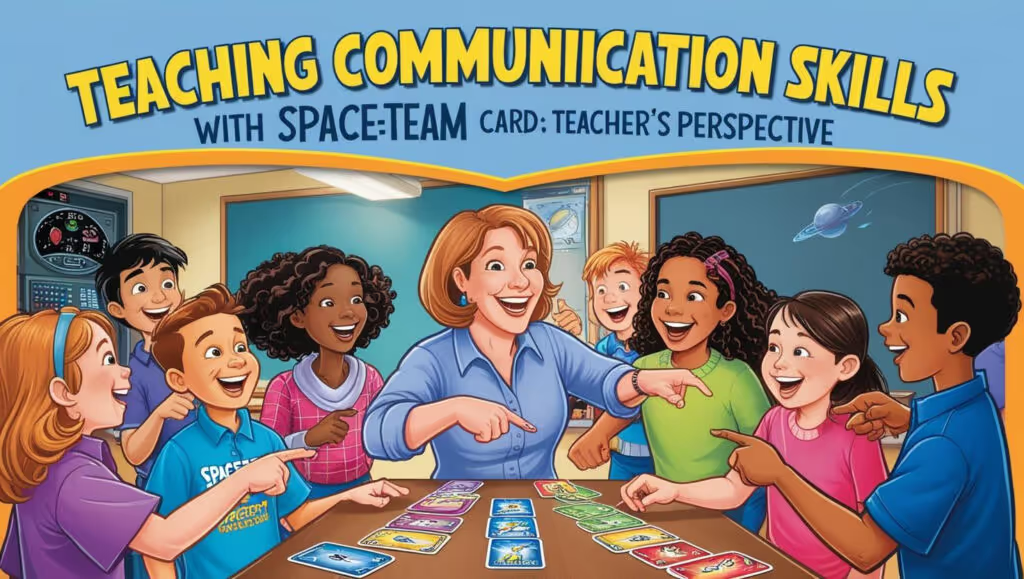
A crew learning the Spaceteam card game, one clear call at a time.
I am Spector, a dad to Alex, 7, and Emma, 10. I also run the game table at our local kids club, so this page is written for teachers, club leaders and youth group volunteers who want a loud game that teaches clear talk. Communication is the whole game here: nothing gets fixed until one player names the exact tool and the right person hears it. If you are a parent looking for family game night coaching instead, start with our Spaceteam teamwork guide and come back to this page for the talk skills.
Affiliate disclosure: this page contains Amazon affiliate links. If you buy through one we may earn a small commission at no extra cost to you, and it never changes the picks below.Why Spaceteam works as a classroom communication lesson
Spaceteam works as a communication lesson because the tools are scattered, so no malfunction gets fixed until a player says the exact tool name and the right person hears it. There are no turns, and the timer ends the debate in about 5 minutes, so a group cannot stay quiet and still win. Every round turns talk into the only move that makes progress.
A quiet cooperative game can still teach planning, and planning matters. But planning lets one strong player solve the table while the rest watch. Spaceteam makes that impossible, because five players shouting at once still need each single call to land. If you want the wider view of how a game table teaches talk, our guide to board games that teach communication skills walks through the same skill across many boxes, and this page stays on the one game.
The four talk moves a Spaceteam round drills for communication
A Spaceteam round drills four talk moves: name the need, aim the call, confirm back, and reset together. They arrive in that order, and each one is forced by the rules rather than taught by an adult.
Name the exact need out loud
Naming the exact need means saying the precise tool, not pointing at the card or calling it a thingy. A malfunction card lists what it needs, so a player who mumbles the wrong word wastes seconds the crew cannot spare. Leaders teach this fastest with one rule before the timer: say the tool name the card prints, then say it again.
Aim the call at one listener
Aiming the call means picking one person and speaking to that face, not shouting at the room. Tools travel only to the player beside you, so a call that names a person travels farther than a call that names nobody. A crew that learns to call one name at a time stops talking over each other within a round or two.
Confirm a call before you act
Confirming means the listener repeats the call back before a tool changes hands. It costs a second and saves a fix, because a wrong tool on the table is a wasted move. This is the listening half of communication, and it is the part most groups skip until a lost round teaches it for them.
Reset together after a blown round
Resetting means the crew restarts without a villain. The timer ends the round for everyone, so the group names the one call that went missing and tries again slower. This is where the lesson lands hardest, and it is the talk skill groups carry into the next round.
Spaceteam communication skills mapped to classroom moves
Use this table to connect the skill, the mechanic that forces it, and the move a leader can run. Every round of Spaceteam puts the same talk skill on repeat.
| Communication skill | In game mechanic | Classroom or group move |
|---|---|---|
| Naming a need exactly | A malfunction card lists the tools it needs, so you say the exact tool name on Spaceteam | Teach the name plus need pattern before the timer |
| Aiming a call at one listener | Tools pass only to the player beside you, never across the table | Ask players to call one name at a time |
| Listening through noise | Your tool sits in another hand and someone shouts for it | Run a listen first rule and ask a player to repeat the call |
| Confirming before you act | A wrong tool wastes a fix, so the crew repeats the call | Have a teammate echo the call back before passing |
| Reading a short command aloud | Every card asks a player to read a command in time | Pair a weaker reader with an adult reader |
| Resetting after a blown round | The timer ends the round and the whole crew restarts | Debrief the one missed call, not the player |
The table is the lesson plan in one view. Pick the skill the group needs most, run one round, and ask about that skill in the debrief.
How to run a Spaceteam communication activity in class or club
Run a Spaceteam activity in three steps: split the room into small crews, teach the call and response pattern, then play one real round and debrief it. The whole thing fits in about 20 minutes once the rules are clear.
Set up small crews of three to six readers
Set up crews of three to six players, because that is the publisher spec and it keeps the tool hunt alive. A class of 24 becomes four crews of six, each with its own box or deck and its own timer. Put at least one confident reader in every crew, and pair a younger or quieter player with a patient partner so the first round stays kind. Our guide to social confidence games for shy players covers the slower warm up if a player freezes at a full table.
Teach the call and response pattern first
Teach the pattern before the timer starts: name the tool, aim the call at one face, and have that player repeat it back. Walk through it once with the whole room in a calm voice, then let each crew run one practice round with the timer off. When the room spans a wide age range, our mixed age game night guide shows how to match one box to a 7 year old and a 10 year old at once.
Then start the real round. The first real round is for noise and laughter, not for a score, so cheer the biggest disaster of the session and let the crew reset.
Debrief one round before you play the next
Debrief means asking what the crew heard and what it said, in that order, before another round. Keep it to two minutes and three questions, then run the next round so the talk fix is still fresh. A crew that debriefs once plays noticeably calmer the second time.
The after round debrief is where the listening lesson lands
The after round debrief is where the listening lesson lands, because the talk that failed is still fresh and the crew can name it. Ask three questions and let the players answer them, not the leader: what did you hear, what did you say that landed, and which single call went missing. The point is to move the group from blaming a player to fixing a call.
End the debrief with one reset promise. The crew names the one call it will repeat clearer next round, then plays again straight away. If the group plays for connection rather than skill, our Spaceteam family bonding guide keeps the same loud game pointed at togetherness. And when the table wins or loses as one, the shared result does the teaching, which our guide to cooperation and teamwork explains across many games.
Spaceteam age, group size and round timing for a group
Spaceteam fits ages 10 and up, seats 3 to 6 players per crew, and runs about 5 minutes a round on the included timer. For a group leader the useful unit is the crew, not the room: run several crews side by side, each with its own deck and timer, and rotate so everyone plays more than once. The publisher says two players is allowed but not much fun, so keep the minimum at three.
The 5 minute round is the leader’s best tool, because it caps each turn at the table and ends before a group gets restless. Play one round, debrief, then rotate the crews so different players talk to each other. If anyone is brand new, our Spaceteam rules guide for first time players walks through a full round step by step, and this page stays on the talk skills.
The numbers to plan around, straight from the publisher, Stellar Factory: 90 game cards in the box, all 6 Systems Go cards to reveal before time runs out, and audio timer modes at 3, 5 and 7 minutes.
Where a Spaceteam communication lesson goes wrong
A Spaceteam communication lesson goes wrong in three predictable ways: the group shouts for volume instead of clarity, calls are aimed at the room instead of one person, and a lost round turns into blame. Each one has a quick fix.
- Volume without clarity. Ask each player to call one name and one exact tool, then have that person repeat it back.
- Calls aimed at nobody. Run the beside you passing rule out loud, and have players point at the person they are calling.
- Blame after a loss. Take the debrief first and name the missed call, never the player, then replay immediately.
If a player keeps talking over the group, our guide to turn taking games that avoid the tantrums covers the slower route where a turn is a talk turn.
Is Spaceteam good for teaching communication skills
Yes. Spaceteam is one of the best single game communication trainers we own, because the tool hunt forces a group to name needs, aim calls, confirm and reset every round, and the 5 minute clock gives honest feedback fast. The real catch is the volume plus the reading load, so a group that needs quiet talk or has early readers should start with a calmer game and add Spaceteam once the calling habit sticks. For box contents and the buy decision, our Spaceteam card game review covers what ships and who it is for.
- Similarities: Both are fully cooperative, both end with the whole group owning one shared result, and both reward talking over silent planning.
- Differences: Spaceteam runs in real time with no turns, while a calm cooperative puzzle moves at a talking pace with time to think.
- Why this game fans will enjoy it: If your group loves the shared win but melts under the timer, run the calm cooperative game first and return to Spaceteam once the calling out habit sticks.
The round that sold me on this game as a communication lesson was at our kids club, not at home. Six kids started by shouting over each other, so we stopped, taught the call and response pattern, and replayed the same round slower. One quiet girl named the exact tool, the boy beside her repeated it back, and the whole crew fixed the ship with seconds left. She did not get louder. She got clearer, and the room heard it.
Frequently asked questions
How does Spaceteam teach communication skills?
Spaceteam teaches communication because the tool that fixes your system sits in another hand, so you must name the exact tool and listen until the right player hears you. A mumbled or misplaced call wastes the round, so clear talk becomes the only way to win.
What communication skills does Spaceteam practice?
Spaceteam practices four talk moves: naming the need exactly, aiming the call at one person, confirming a call before acting, and resetting after a blown round. Each move is forced by the rules rather than taught by an adult.
Can you use Spaceteam in a classroom?
Yes, Spaceteam works in a classroom or youth group as long as you run small crews of three to six players aged 10 and up with a reader for anyone still learning. Each crew plays its own about 5 minute round, so a full class can rotate through quickly.
What age is Spaceteam for in a group setting?
Spaceteam is rated for ages 10 and up, because every card asks a player to read a short command and shout it before the timer ends. A younger child can join a crew with an adult who reads their cards aloud.
How long should a Spaceteam communication activity run?
Plan about 20 minutes: a short talk about the exact name pattern, one practice round with the timer off, one real about 5 minute round, and a two minute debrief. Stop while the group is still asking for another round.
How do you debrief a Spaceteam round for communication?
Ask three questions after the round: what did you hear, what did you say that landed, and which single call went missing. Naming one missed call turns a lost round into the next lesson without blaming a player.
Is Spaceteam good for group communication or just for fun?
Spaceteam is good for group communication because the fun and the skill come from the same act, naming a need and hearing it land under a 5 minute clock. The game gives fast feedback, so the group sees right away whether a call was clear.
Editorial Standards
We never accept payment for positive reviews. Affiliate links support our work at no cost to you. All games are tested with our family before review.