
How to Play Blokus Solo | Step by Step Puzzle Strategy
I'm a dad who fell back in love with board games so I could play them with my two kids, and now I share honest, parent-first reviews of what we love. I'm not on social media, I quit it a long time ago.
The Quick Answer
Learn how to play Blokus solo, including the official one player brain teaser, the house one color variation, setup, scoring, and strategy.
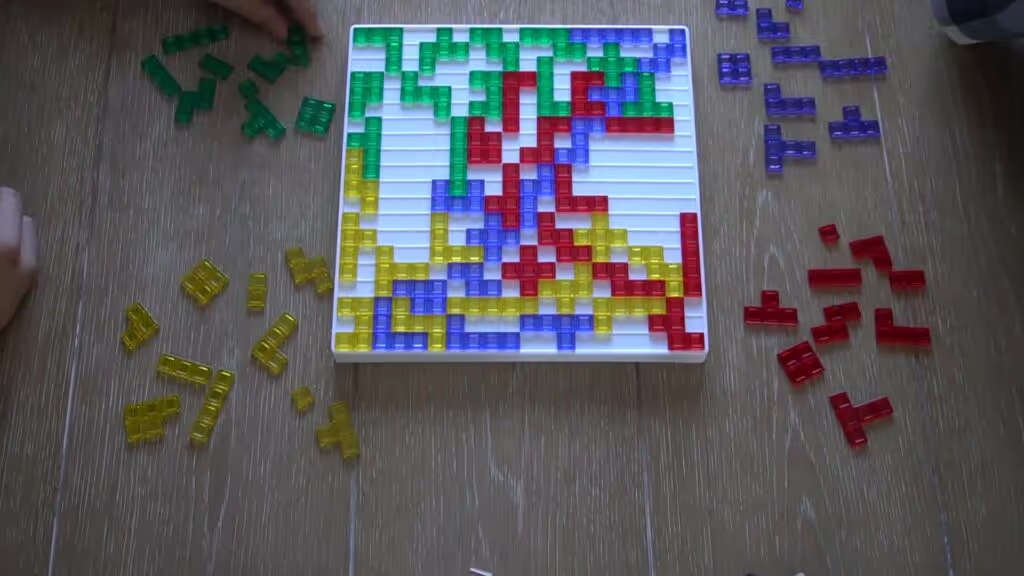
A solo Blokus challenge turns each placement into a spatial puzzle.
That is the short answer. The standard Blokus game is designed for 2 to 4 players, but the rulebook editions and official rules references include a solo challenge. If you only have one color set, that is still a useful house variation, as long as we use a clear goal instead of pretending the competitive rules have not changed.
I tested the practical version with Alex and Emma on the floor. Emma quickly found that a five square piece placed too late can wreck the rest of the puzzle. Alex kept trying to save every small piece until there was nowhere useful to put them. That is when solo Blokus starts to feel less like a lonely competition and more like a friendly problem to solve.
Official Blokus Solo Rules Versus House Rules
Official Blokus solo uses all four colors and all 84 pieces, while the one color method is a house practice variation with a different goal.Official solo brain teaser
The official one player challenge keeps the basic Blokus placement rules and asks you to control all four colors. The usual goal is to place all 84 pieces on the 20 by 20 board. Some rulebook editions also offer a second solitaire challenge using all 20 four square pieces in an exact 8 by 10 rectangle.
Check the rulebook in your box because edition wording can differ. The important point is that this is not the same as using only one color and declaring victory after placing a handful of pieces.
House one color variation
For a quicker practice game, use one color’s 21 pieces. Your goal is to place as many as you legally can. When you get stuck, count the squares in the pieces left over. Fewer remaining squares is a better result, but it is a house score, not the official competitive score.
The classic placement rules still apply. Your first piece must cover your chosen corner, and every later piece must touch one of your pieces at a corner without touching its side. Pieces cannot overlap, and pieces of other colors may touch freely.
What You Need for Blokus Solo
You need very little beyond the box:
- The Blokus board
- All four color sets for the official brain teaser, or one 21 piece set for the house variation
- The rulebook from your edition
- A timer if you want a timed challenge
- A pencil and scrap paper for tracking your score or remaining shapes
How to Play the Official Blokus One Player Brain Teaser
The official challenge is simple to explain and hard to finish. Follow these steps in order.
- Set out the board. Use the full 20 by 20 grid with plenty of table space around it.
- Sort all four colors. Keep the 21 shapes for each color together. Do not mix the sets while you are learning the puzzle.
- Choose a starting corner. Place one piece from a color so that one square covers that color’s corner. The exact shape does not matter, but the corner placement does.
- Play one color at a time. After the first piece, every new piece of that color must touch an existing piece of the same color at one or more corners.
- Use all four colors. Return to the turn order after each placement. Each color needs its own first corner placement before later pieces can connect to it.
- Keep scanning for the hardest shapes. Large pieces are easier to place early, while the one and two square pieces can fill small gaps later.
- Stop only when no legal placement remains. The standard challenge succeeds when all 84 pieces are on the board. If you cannot finish, record the squares left and use that result to improve the next attempt.
There is no need to rush the official challenge. I use a small note beside the board to mark the four starting corners and the shapes I still need to place.
How to Play the One Color House Variation
The one color version is my go to solo warm up because it teaches the same corner connection rule without the mental load of four separate territories.
- Choose one color and place all 21 pieces beside the board.
- Place the first piece in that color’s corner.
- On every later turn, place a piece that touches your existing territory at a corner only.
- Scan from the largest pieces to the smallest, checking all four orientations.
- If a shape has no legal home, set it aside and continue with another piece.
- Stop when you cannot place any remaining piece.
- Count the squares in the unplaced pieces. A lower total means a stronger solo practice result.
The How to Play Blokus guide explains the full competitive game and the standard player count. The Blokus review covers who the game suits at a family table. If you want a different tile placement challenge, our games like Blokus guide compares other options.
Blokus Solo Strategies That Actually Help
Place large pieces early
Large pieces create the most dramatic placement problems when the board is already crowded. I usually begin with a five square piece, then look for a second large piece that can extend diagonally into fresh space. This is strategy, not a promise that the first move wins.
Save small pieces for the end
The one and two square pieces are valuable because they can fit into spaces that larger pieces cannot use. Do not spend every easy small opening in the first few turns. Save a few options for the final board.
Make more than one connection
A piece that touches two of your existing pieces can give you more future connection points. At the same time, avoid making a wall so tight that you box yourself into one corner. A good solo layout should have several promising directions.
Think in diagonals
Blokus rewards diagonal movement because corners are the legal connection points. Picture a staircase of pieces instead of a solid block. This makes it easier to find a legal spot for the awkward L and T shaped pieces.
Count squares, not pieces
Two unplaced pieces can be worse than three unplaced pieces if those two pieces contain more squares. The official game and the house variation both reward understanding why square count matters.
Choose the Right Blokus Solo Challenge
| Solo format | What you control | Goal | Best for | Rule status |
|---|---|---|---|---|
| Blokus one player brain teaser | All four colors and 84 pieces | Place every piece legally | A serious spatial puzzle | Official variation in the rulebook |
| Blokus one color practice | One color and 21 pieces | Place as many as possible, then count remaining squares | Learning the corner rule or a quick warm up | House variation |
| Blokus timed challenge | One or all colors, depending on your house rule | Place as many pieces as possible before time expires | Speed and friendly competition | House variation |
Alex, seven, likes the timer because every move feels urgent. Emma, ten, prefers the four color challenge because she can plan several connections ahead. They argue about which version is more fun, which is exactly the kind of low stakes debate I want around our table.
Common Blokus Solo Mistakes
Treating all 21 pieces as a guaranteed win
One color pieces may not all fit, even when you make legal placements. A house game should measure the squares left, not promise that every shape will fit.
Starting in the center
A first piece must begin in the chosen corner in the standard game. The center becomes available later through corner connections.
Letting your own pieces touch along a side
Your own pieces may share a corner, but they may not share a side. Check the connection before you commit.
Using every small piece too soon
Saving a few small pieces can make the final turns much easier. Keep options open instead of taking the first available gap.
Mixing editions
The official solo challenge and the 20 piece rectangle challenge are not the same objective. Read the rulebook that came with your copy before starting.
Frequently Asked Questions About Blokus Solo
Can you play Blokus by yourself?
Yes. The official one player brain teaser asks you to place all four colors and all 84 pieces, while a one color practice game is a separate house variation.What is the goal in Blokus solo?
The official brain teaser aims to place all 84 pieces. In the one color house variation, place as many pieces as possible and count the squares left.Do you use all 21 pieces when playing Blokus solo?
You aim to use all 21 pieces in the one color house variation, but you may not be able to fit every piece. The official brain teaser uses all 21 pieces from each of the four colors.What is the first move in Blokus solo?
Place the first piece so that one square covers your chosen starting corner. Every later piece must connect to your own color at a corner without sharing a side.Is one color Blokus an official solo mode?
No. A one color game is a house practice variation. The official solo brain teaser uses all four colors and all 84 pieces.How many pieces are in Blokus?
The standard game has 84 pieces, with 21 differently shaped pieces in each of four colors. The board has 400 squares arranged in a 20 by 20 grid.Editorial Standards
We never accept payment for positive reviews. Affiliate links support our work at no cost to you. All games are tested with our family before review.