
How to Play Quest for El Dorado | Setup, Rules, and Strategy
I'm a dad who fell back in love with board games so I could play them with my two kids, and now I share honest, parent-first reviews of what we love. I'm not on social media, I quit it a long time ago.
The Quick Answer
Learn how to play Quest for El Dorado with 2 to 4 players. Master setup, route cards, action cards, market buying, coins, caves, and winning strategy.
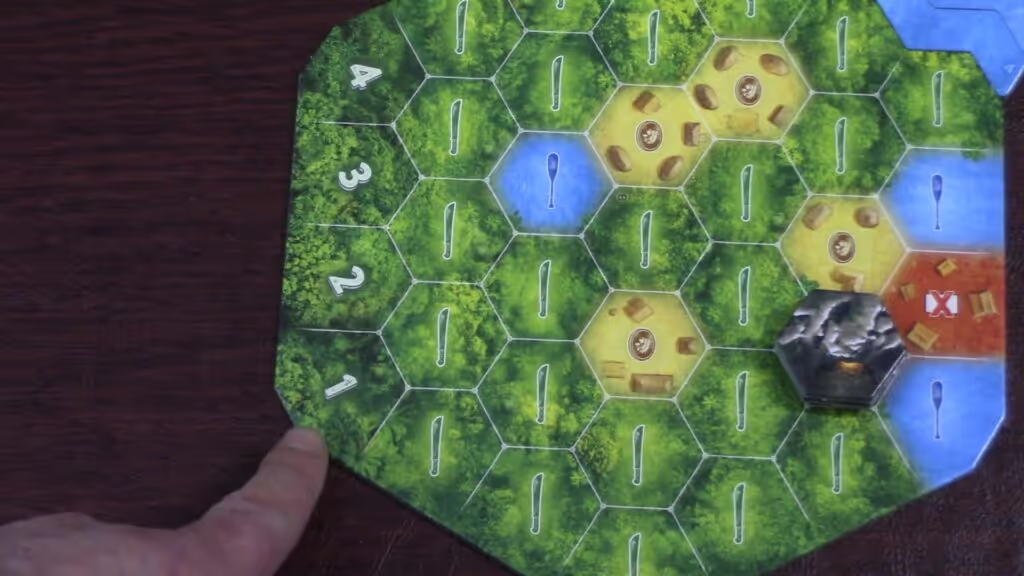
Planning the next move on The Quest for El Dorado game board.
I like this game because the rules teach themselves through the route. You start with movement cards, buy better cards, and watch a thin starter deck turn into a plan. The game is competitive by default. Solo and cooperative play are separate variants, not standard base game modes.
Quest for El Dorado Quick Facts
- Players: 2 to 4
- Designer: Reiner Knizia
- Publisher: Ravensburger
- Playtime: about 30 to 60 minutes
- Setup: about 5 minutes
- Ages: 10 and up
- Win condition: Reach El Dorado and win the final round tie breakers if needed
How to Set Up Quest for El Dorado
- Build the terrain using the seven terrain tiles and two terrain strips. Place the ending tile at the far end of the route.
- Prepare the six starting market stacks. The market is a board of card stacks, not a deck that refreshes one card at a time.
- Give each player an expedition board and eight cards: 4 Travelers, 3 Explorers, and 1 Sailor.
- Shuffle each player’s deck and place the starting player hat on the first expedition board.
- Place each player’s adventurer on a numbered starting space.
- Put the blockades, cave tokens, and action cards where everyone can reach them.
There are no camp tokens in the base game. The red spaces are base camps on the map, and entering them removes the required number of cards from the game.
How to Play a Turn in Quest for El Dorado
Every turn has three phases.
- Play cards. Use cards to move your piece, use action cards, or buy up to one market card. Each card can be used only once.
- Discard. Put played cards on your discard pile. You may also discard cards you do not want to keep.
- Draw. Draw until you have four cards again. If your draw pile runs out, shuffle the discard pile and finish drawing.
Play movement first if you want the card’s movement value. You cannot normally use the same card for movement and buying. The cards you buy go to the discard pile, not directly into your hand.
Quest for El Dorado Route Card Rules
A route card must match the symbol on the space and have enough power for that space. You cannot combine two low value cards to enter one high value landscape space. Leftover power can carry to the next adjacent space of the same type.
| Route space | How to enter it |
|---|---|
| Jungle | Play a green card with a machete symbol and enough power. |
| Water | Play a blue card with a paddle symbol and enough power. |
| Village | Play a yellow card with a coin symbol and enough power. |
| White card | Choose the matching machete, paddle, or coin symbol. |
| Rubble | Discard the number of cards shown on the space. |
| Base camp | Remove the number of cards shown on the space from the game. |
| Mountain | You cannot enter or cross it. |
| Occupied space | You cannot move onto another player’s piece. |
| Blockade | Meet its power, remove it, and keep it as a tie breaker. |
The exact power values and names vary by edition, so use the symbols and rulebook in the copy in front of you.
Quest for El Dorado Action Cards
Action cards are played during your turn and then follow the instruction printed on the card.
- Scientist: Draw one card, then optionally remove one card from your hand.
- Transmitter: Take an available market card without paying. Put it on your discard pile.
- Cartographer: Draw two cards and play them this turn.
- Compass: Draw three cards, then remove the Compass from the game.
- Travel Log: Draw two cards, remove up to two cards from your hand, then remove the Travel Log.
- Native: Move one space while ignoring that space’s requirements. It cannot enter an occupied space or a mountain.
The 2023 edition has a larger card set. Check the rulebook for the exact effects of cards not in the classic six card sequence.
How to Buy Cards and Use Coins in Quest for El Dorado
You may buy one market card each turn, whether or not you moved.
- A card with a coin symbol pays its printed value.
- Every other card is worth half a coin.
- Add the values of the cards you play until you reach the price of the market card.
- The purchased card goes directly to your discard pile.
- There is no change from the market.
At setup, you can buy from the six bottom stacks. When a stack empties, its next stack becomes available. If a market space is open, you may buy from any remaining market stack and move that stack into the open space. Purchased cards take time to return to your deck, so buying is not an instant upgrade.
Blockades, Caves, and the End of Quest for El Dorado
Blockades block a route until a player meets their power requirement. The player who removes a blockade keeps it. Blockades matter because the player with the most blockades wins a tie after the final round, with the highest blockade power as the next tie breaker.
Cave tokens are optional game elements that can thin cards from the deck. They are not coins, and they are not a second market.
Reaching one of the three finishing spaces triggers the final round. Every player still in the race takes one more turn. If several players reach El Dorado, use the blockade tie breakers.
Best Strategy for Quest for El Dorado
The best beginner plan is simple: buy movement that matches the route you can actually use.
- Keep cards for jungle, water, and village spaces in balance.
- Do not spend every turn buying a card that cannot move you now.
- Use coins for movement when that movement gets you through the route more efficiently.
- Remove weak cards at base camps when you can, but do not thin your deck into a hand full of one time cards.
- Take blockades when the route gives you a chance. They remove an obstacle and help in the final tie breakers.
- Look at the whole route early, then choose the next move based on the cards in your hand.
- In a two player game, move both pieces forward. You need both to reach El Dorado.
Quest for El Dorado with 2, 3, or 4 Players
Two Players
The two player rules give each player two adventurer pieces. Place the first player’s pieces on starting spaces 1 and 3, and the second player’s pieces on spaces 2 and 4. Each card must be assigned to one piece, and its power cannot be split between both pieces. You win when both of your pieces reach El Dorado.
Three Players
Three players give you more route choices while keeping the market and table conversation manageable. I like this as the first competitive player count for teaching the game.
Four Players
Four players make blocking and market timing more important. Slow down enough to notice which cards your neighbors need, but do not buy a card only because an opponent cannot afford it.
Teaching Quest for El Dorado to Kids
Start with a short practice turn. Let the child move one piece, buy one card, discard, and draw back to four. That sequence is the whole game.
At our table, Alex understands buying movement sooner than he understands card values. Emma notices when a cheap card gives her three useful turns. The lesson lands when the deck visibly improves, not when an adult explains probability before the first roll.
Solo and Cooperative Quest for El Dorado Variants
The base game is competitive for 2 to 4 players. Solo and cooperative sheets are external variants unless your edition includes a specific official sheet. For a solo setup and checklist, see our Quest for El Dorado solo guide.
For cooperative play, treat the rules as a separate variant and check the source carefully. Our Quest for El Dorado cooperative guide is a useful place to compare that variant, but it should not be treated as the base game rulebook.
Quest for El Dorado Expansions
Heroes & Hexes adds cards, familiars, the Heroes Tavern, and demon spaces. The Golden Temples is a separate temple focused game that can be played on its own. Neither expansion is required to learn or enjoy the base race.
What to play when this one stops being enough. El Dorado is a 10 and up box with the lightest rules in the deck building family, which is exactly why it works for a family and exactly why a teenager eventually finds the four card hand limiting. When that happens, Dominion is the natural step up: the same buy cards and improve your deck loop, but with a deck you assemble yourself, a 13 and up box, and a market of 17 piles that changes every single game.
Frequently Asked Questions About Quest for El Dorado
How do you set up Quest for El Dorado?
Build the terrain and ending tile, prepare the six starting market stacks, give each player 4 Travelers, 3 Explorers, and 1 Sailor, shuffle each deck, and place the pieces on the numbered starting spaces.How many cards do you start with in Quest for El Dorado?
Each player starts with 8 cards: 4 Travelers, 3 Explorers, and 1 Sailor. You begin each turn with a hand of 4 cards.How do you play a turn in Quest for El Dorado?
Play cards to move, use action cards, or buy up to one market card. Discard the played cards, then draw back up to 4 cards.Can you combine cards to enter a high value space?
No. One card must match the space symbol and have enough power for that space. Leftover power can move through adjacent spaces of the same type, but two low value cards cannot enter one high value landscape space together.How are coins used to buy cards?
Coin cards pay their printed value, while other cards are worth half a coin. You may buy one market card per turn, and the purchased card goes to your discard pile.What happens when the player reaches El Dorado?
Reaching a finishing space triggers a final round. Every remaining player takes one more turn, then the player with the most blockades wins. The highest blockade power breaks a further tie.How does two player mode work?
Each player controls two pieces and must bring both to El Dorado. Each card is assigned to one piece, and its power cannot be split between both pieces.Can Quest for El Dorado be played solo?
Yes, through a solo variant sheet, but solo is not a standard competitive mode in the base game. Follow a clearly sourced solo setup such as our dedicated solo guide.Is Quest for El Dorado good for kids?
It is a strong choice for older children and families because the rules are light, the turns are quick, and deck improvement gives kids a clear goal. The box lists age 10 and up.Editorial Standards
We never accept payment for positive reviews. Affiliate links support our work at no cost to you. All games are tested with our family before review.